The D8A mentoring program: weekly 1:1 until you sign
A weekly one-to-one call, a written plan built on your profile, named recruiters for your market, and mock interviews. Here is who it is for, what a month looks like, what it costs, and what it will not do.
Most people who get stuck looking for a data job do not need another course. They need someone to look at their actual situation, tell them what to do this week, and check next week that it was done. That is what the mentoring program is. This article explains how it works, plainly, so you can decide whether it is for you.
What it is
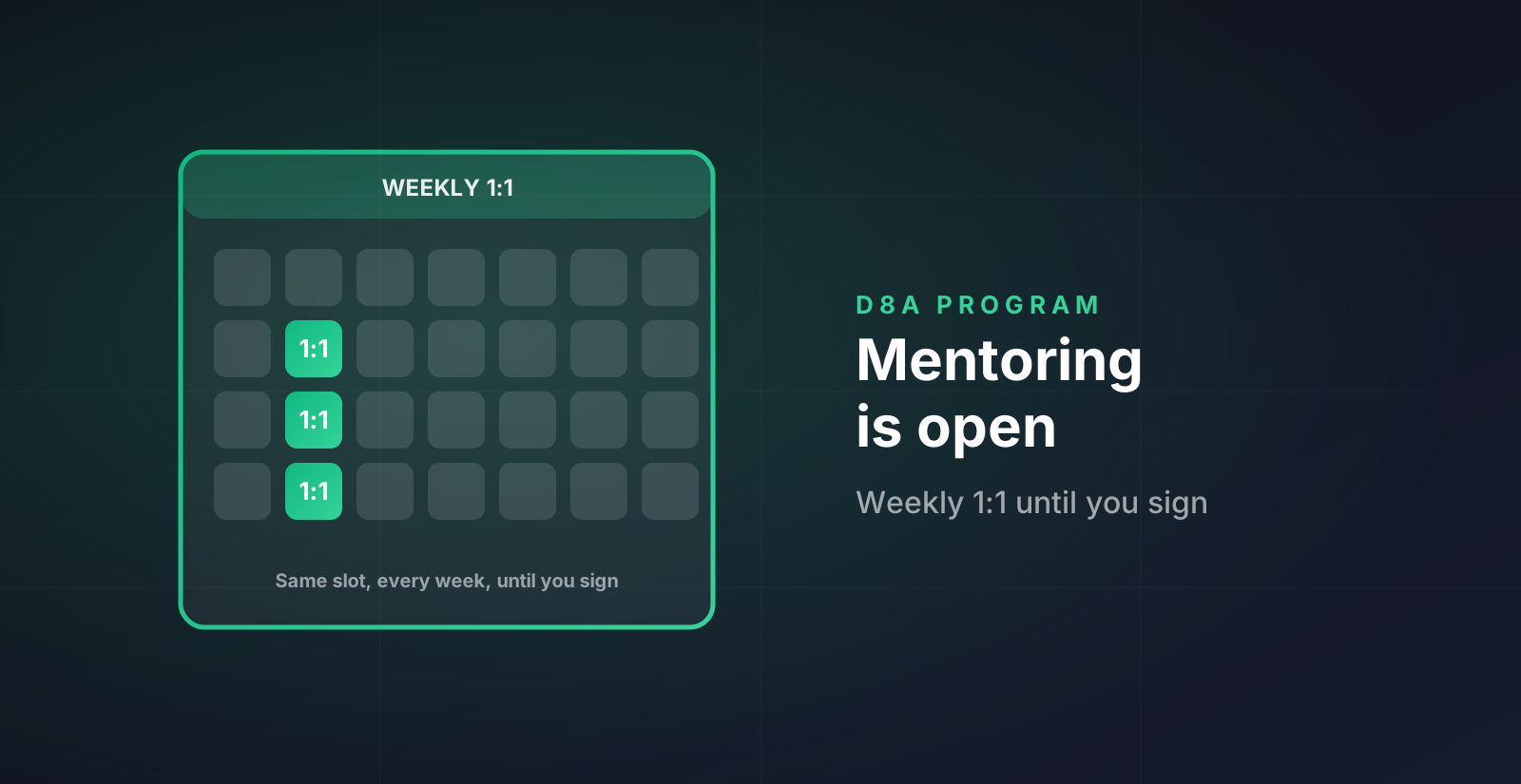
A weekly one-to-one call, same slot every week, with Marius, the founder of D8A. Between calls, a direct line on Discord. If you have an interview tomorrow morning, you do not wait until next Tuesday.
The goal is one thing: a signed offer, on a payroll or as a freelancer. Everything in the program is organised around that, in three steps.
- 1
Pick the target, build the proof
One role, one market, one seniority, written down. Then the projects that fit that target, rebuilt to look like the work of that role rather than coursework. Your CV and LinkedIn rewritten for it, and screened with the same filters a recruiter uses. If you are hesitating between payroll and freelance, we decide it on your numbers, not on a feeling.
- 2
Go get seen
A list of named recruiters and hiring managers for your country and target role, pulled from the D8A jobs pipeline, and the message that opens the conversation. Referral and warm-intro scripts, because the offers that matter are often not the posted ones. Interview preparation aimed at whatever the first conversations show is missing.
- 3
Close it
The case study or take-home a company sends you, reviewed before you send it back. Salary or day-rate negotiation with the numbers for your market in front of you. If there are two offers, we compare them. Then the first ninety days, or the first contract and invoicing if you went freelance.
These are steps, not months. Nobody is held to a calendar. Step 3 starts when step 2 produces interviews, and for some people that is week four. On average, people stay about two and a half months.
What you keep
Two things from the program stay with you after it ends.
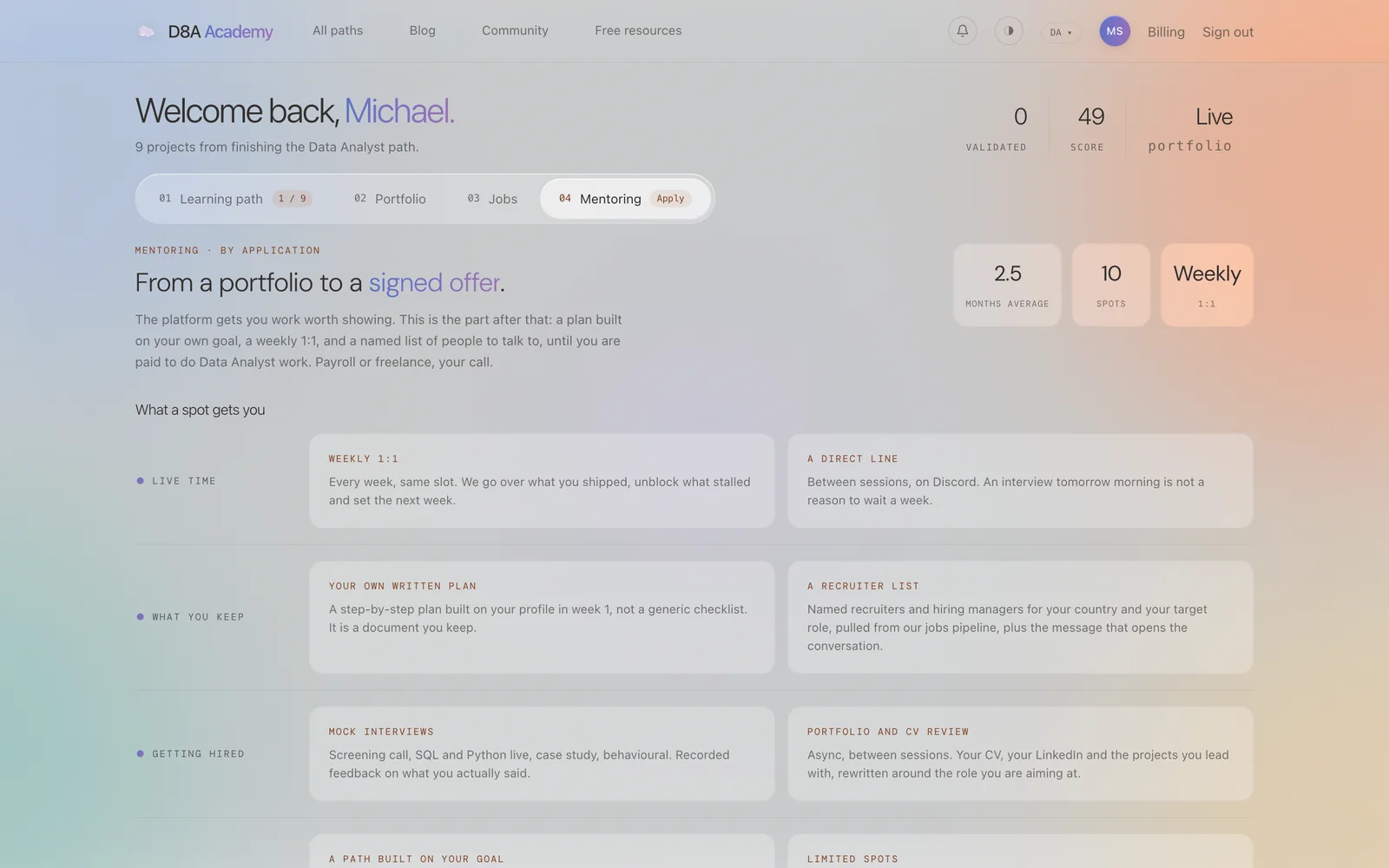
A written plan. Built on your profile in week one, step by step. Not a generic checklist. A document you can reread in six months.
A recruiter list. Named people for your market, with the message that worked. You will need it again at your next move.
The rest is live time: the weekly call, the Discord line, mock interviews (screening call, SQL and Python live, case study, behavioural) with recorded feedback on what you actually said, and async reviews of your CV, LinkedIn and the projects you lead with.
Who it is for
It is for people who already have a bit of proof and are stuck at the next step. Typical profiles:
- You finished a path or a few projects, applied to forty jobs through forms, and heard nothing. The problem is usually positioning and channel, not skill.
- You are already in data and want to move up, change country, or go freelance, and you do not know how to price yourself.
- You have interviews but you lose them at the case study or the technical round.
It is not for people who have not built anything yet. If you are starting from zero, the paths and the free intro courses are the right first step, and they cost much less. Come back when you have two or three projects to show.
What it costs, and why there is a form
$149 a month for the first five people. After that, $299 a month. The struck-through price on the page is the future price, not an invented "was" price.
There is no buy button. Every spot is one hour a week of real time, so only a few are open at once. You fill in a form: where you are, what you can already show, what you are aiming at, how many hours a week you can put in, and when you want to start. We read every one and answer within two working days. The answer is accepted, waitlisted, or not this time. "Not this time" is usually about timing, and we say why.
We do not promise a job. We take the profiles we believe we can actually help, which is exactly why there is a form instead of a checkout. If a program promises you a job for a fixed price, ask how they can control the hiring decisions of companies they do not work for.
Who is on the other side of the call
Marius, who built D8A. Senior freelance data analyst, ten years in the job, with clients such as Hermès, LVMH, Publicis, Rimowa, Sonepar and Rexel. He has sat on both sides of the table: as the candidate, and as the person who had to say yes or no to one. The recruiter list, the pricing advice and the case study reviews come from that, not from a textbook.
How to apply
Sign in, or create a free account, and open the Mentoring tab in your dashboard. The form has three short parts: you, your proof, your target. Ten minutes. Be honest in the "what is blocking you" box; it is the part we read most carefully.
If you are not sure whether to apply, apply. The worst case is a clear answer and a reason, within two days.